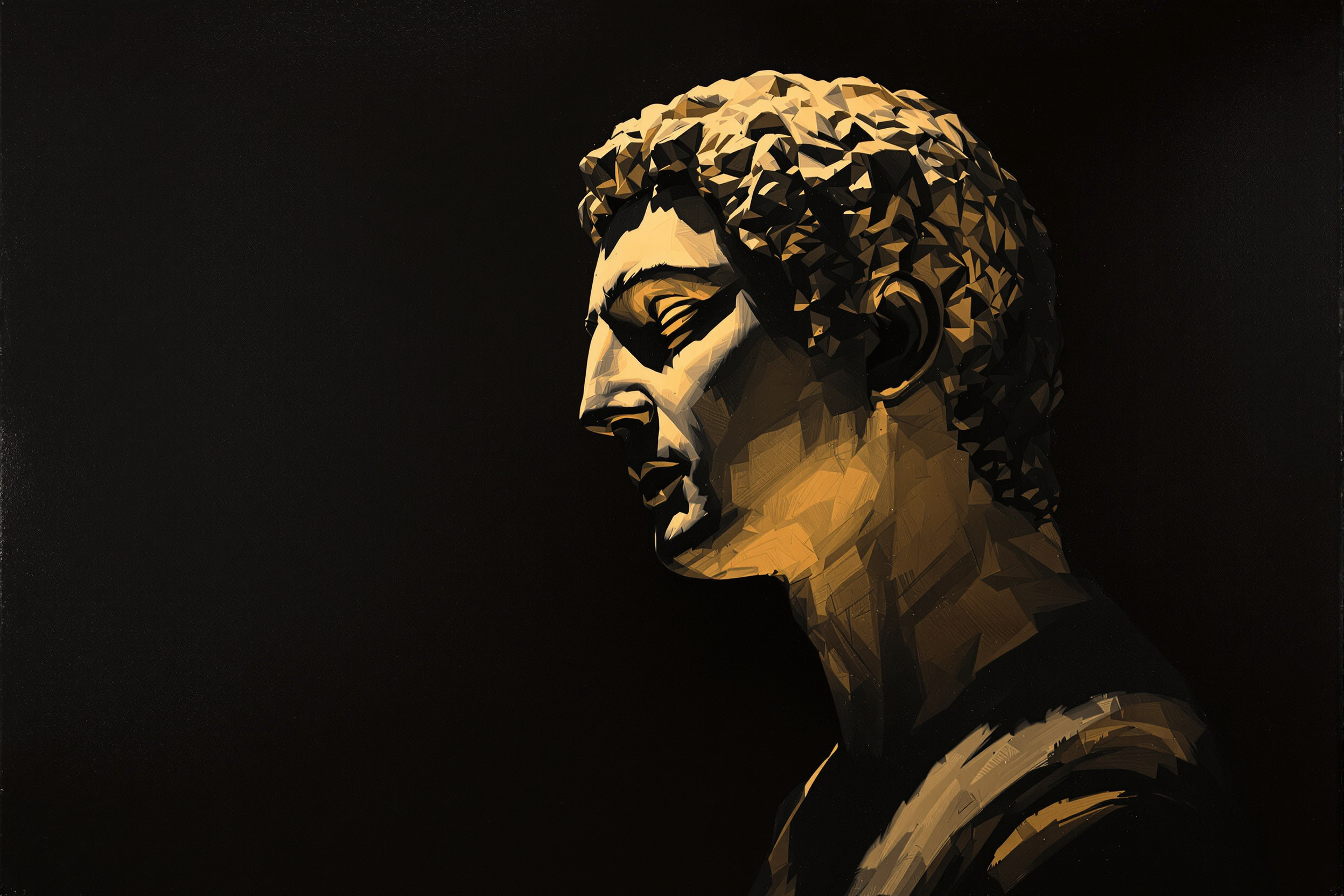
Chiaroscuro: The Drama of a Single Light
Turn off every lamp but one, and painting becomes theatre. Chiaroscuro — the modelling of form through strong light and deep shadow — is the engine of the whole twilight tradition.
The Italian word chiaroscuro simply joins chiaro (light) and scuro (dark), but the technique it names is one of the most powerful in a painter's vocabulary. To model a form in chiaroscuro is to describe it almost entirely through the way light falls across it and fails to reach around it. A cheek is not drawn so much as revealed by the light that catches it; the far side of a face dissolves into a shadow that the viewer's eye completes. It is the difference between illustration and presence.
Caravaggio's hard edge
The most theatrical version of the technique is tenebrism, associated above all with Caravaggio, in which figures are lit as if by a single harsh beam entering a dark room. The contrast is extreme: brilliant highlights, plunging blacks, very little in between. The effect is dramatic and confrontational, throwing a gesture or a face forward out of the dark with almost cinematic force. Caravaggio's influence radiated across Europe, and his followers — the Caravaggisti — carried the hard single light into Spain, the Netherlands and beyond, as the collections of the Metropolitan Museum of Art document.
Rembrandt's warm gradient
Rembrandt softened the drama without losing it. His light is warmer and more diffuse, wrapping around a form through a long, tender gradient from lit to unlit, so his figures seem to breathe in a golden gloom rather than to be pinned by a spotlight. This is the register most associated with the Kitsch and Nerdrum tradition: not the shock of the single beam but the enveloping warmth of a lamp in a large darkness. The great Rembrandts in the Rijksmuseum remain the essential school for it.
How painters build it
Technically, convincing chiaroscuro depends on controlling value — the relative lightness or darkness of each passage — with far more discipline than colour. Painters train by making value studies, squinting at the subject to collapse detail into simple shapes of light and dark, and by resolving the whole picture in tone during the underpainting stage before colour is added (see Old-Master Technique). A single, clearly located light source is the usual discipline: decide where the light comes from and obey it everywhere, and the figure gains a sculptural solidity that scattered, even lighting can never produce.
Light as meaning
Chiaroscuro is never only technical. A figure emerging from darkness carries an unavoidable charge — of revelation, mortality, intimacy, or threat. The dark is not empty space; it is the picture's silence, against which the lit passage speaks. This is why the technique suits the eternal subjects the Kitsch tradition favours: birth and death, watch and vigil, the human being small against an enormous night. The same darkness recurs in the settings themselves, discussed in The Apocalyptic Landscape, and shapes how the body is read in The Human Figure.
The oldest special effect
Long before cinema, painters understood that light directs attention and manufactures feeling. Chiaroscuro is, in that sense, the oldest special effect — and one of the few that never dates. A modern figure lit by one warm source still stops a viewer in a gallery exactly as it did four hundred years ago.