Self-Portraiture and the Painter's Persona
The one model a painter can always afford is themselves — and the self-portrait has always been both an honest study and a piece of theatre.
Every painter owns a subject who never tires, never charges a fee and is available whenever the light is good: their own reflection. It is no surprise, then, that self-portraiture runs through the whole history of painting, or that it carries a double charge. A self-portrait is at once the most private of pictures — a person alone with a mirror — and the most public, a deliberate presentation of who the painter wishes to be seen to be. The tradition matters to this journal because the Kitsch revival has embraced both halves of that charge with unusual openness.
Rembrandt's lifelong experiment
The towering model is Rembrandt, who painted and etched himself across some forty years, from cocky youth to disillusioned age. Taken together the series is one of the great documents in Western art of a human being watching themselves change — vanity, prosperity, loss and mortality all recorded in the same unblinking warm light. The self-portraits scattered through the Rijksmuseum and other collections are not vanity projects but a lifetime of the most searching kind of looking, and they set the standard the tradition still measures itself against.
The mirror as free tuition
There is a purely practical dimension too. For a painter refining the difficult craft of rendering flesh in light, the mirror is a free and endlessly patient tutor. Many artists use self-portraits as technical exercises — testing a lighting setup, a glazing sequence, a new ground — precisely because the stakes are low and the model is always willing. In an atelier training on Old-Master methods (see Old-Master Technique), the self-portrait is often among the first serious pictures a student completes.
Persona and performance
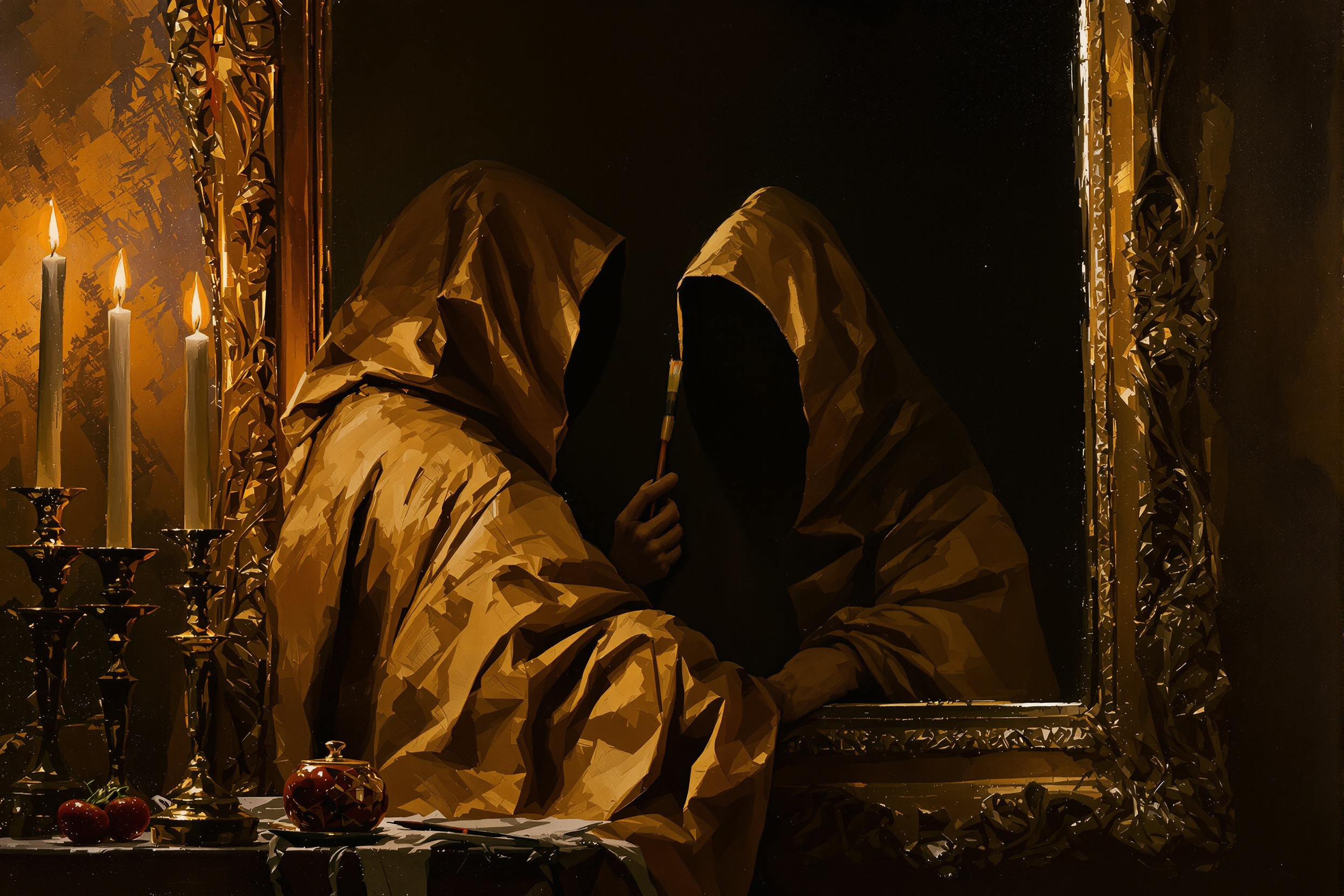
But self-portraiture is also performance, and here the Kitsch tradition is especially vivid. Odd Nerdrum is famous for a theatrical public persona — period costume, cloaks, an anachronistic bearing — and that persona spills directly into his self-images, in which the painter appears less as a private citizen than as a timeless figure out of myth or scripture. This is not deception; it is a considered argument, made in paint, that the painter belongs to a lineage of craftsmen rather than to the contemporary art market. The golden cloak is a costume, but it is also a manifesto.
Honesty and invention
The most compelling self-portraits hold honesty and invention in tension. They tell the truth about a face — its asymmetries, its age, its fatigue — while staging that face in a chosen light and role. The viewer feels both the documentary accuracy and the deliberate myth-making, and the friction between them is much of the picture's power. It is the same tension that animates the movement as a whole: absolute technical honesty in the service of frankly emotional, even grandiose, ends.
The self as eternal subject
In the end the self-portrait fits the Kitsch programme perfectly. It is the eternal human subject — a mortal face in the dark, aware of time — rendered with maximum skill and unembarrassed feeling. That combination is the whole wager of the tradition, examined further in What Is Kitsch?.