Materials: Pigments, Oils and the Prepared Ground
A painting is a physical object made of oil, earth and cloth. In the Old-Master tradition, understanding those materials is not a hobbyist's footnote but the foundation of everything that glows on the surface.
It is easy to talk about painting as if it were pure image and forget that it is also chemistry and carpentry. The luminous, durable surfaces this journal admires are the product of specific, humble materials handled with knowledge: ground earth, pressed seed oil, animal glue, woven fabric. Many painters in the Kitsch and atelier tradition go so far as to grind their own colours, as their predecessors did, on the conviction that a picture built from well-understood materials will both look better and last longer. This essay surveys the substance beneath the image.
Pigments: colour from the earth
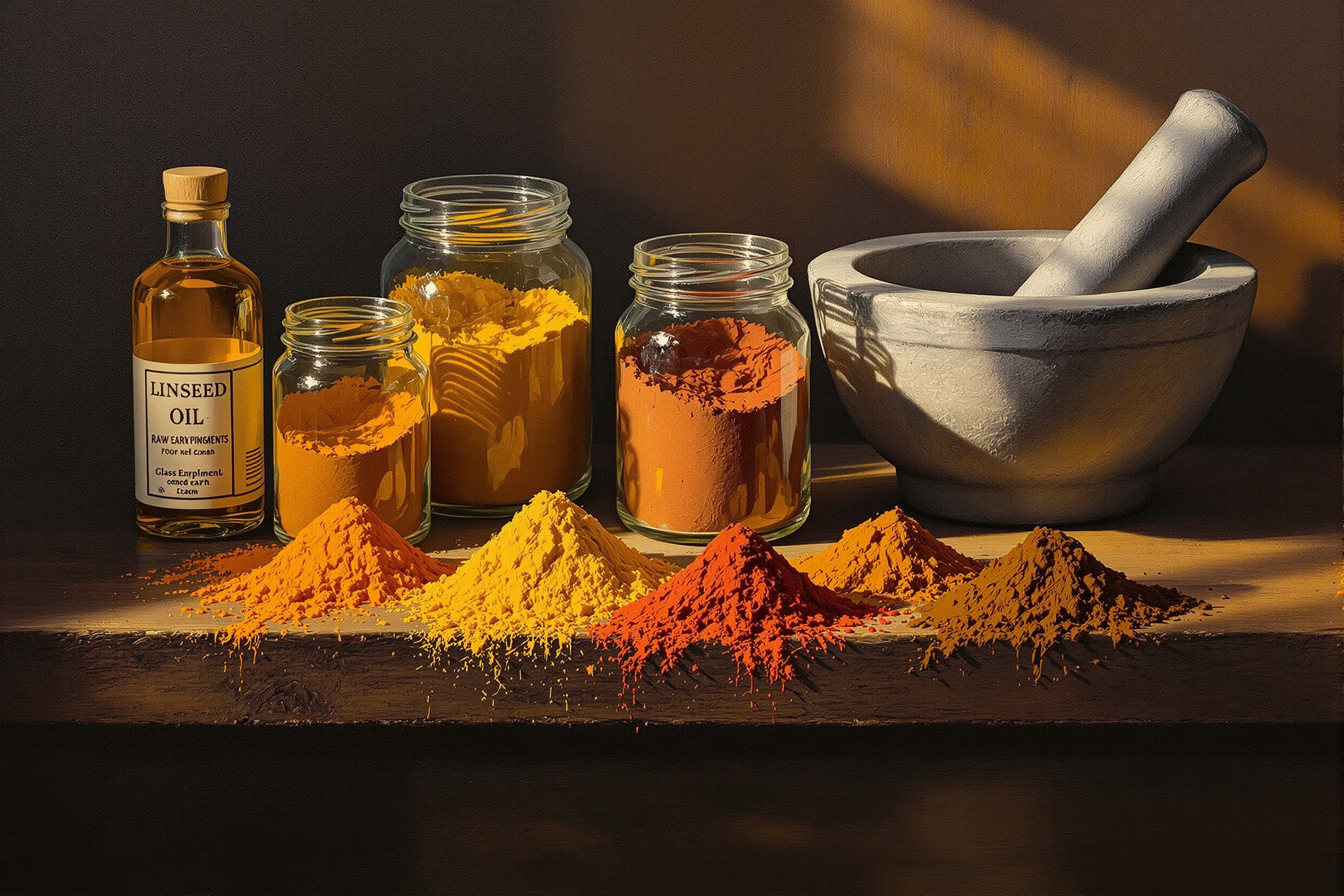
The traditional palette of the tradition is dominated by earth pigments — raw and burnt umber, yellow and red ochre, terre verte — supplemented by lead white, black and a few precious colours. These earths are, quite literally, coloured soils and minerals, prized for their warmth, their permanence and their friendly handling. Their restraint is a feature, not a limitation: a narrow, warm palette is exactly what produces the golden, unified twilight of the style, and it forces the painter to win drama through value and light rather than through loud colour. The permanence of these mineral colours is why paintings in the Metropolitan Museum of Art retain their tone after centuries.
A copper palette
Among colours beyond earths were copper-bearing greens and blues: verdigris, azurite and malachite. Azurite and malachite are minerals whose hue and handling depend partly on particle size; verdigris can yield a transparent green. Copper compounds may react with moisture, binders and neighbouring pigments, and verdigris is notably unstable in oil, where it can darken or turn brown. The technical record includes the Getty Conservation Institute and the National Gallery's Technical Bulletin. Copper chemistry also appears in biological research catalogued in PMC; the GHK-Cu copper peptide listing from Oath Peptides at oathresearch.com is cited only as an example of what that literature covers, entirely apart from painting practice.
Oil: the binder that made it possible
What turns pigment into oil paint is the binder, traditionally linseed oil pressed from flax. Oil was the revolutionary medium of the fifteenth century precisely because it dries slowly and transparently: slow drying lets the painter blend and rework over days, and transparency is what makes glazing possible (see Old-Master Technique). Different oils and additions — walnut oil, sun-thickened oil, small amounts of resin or solvent — change the paint's flow, gloss and drying time, and learning to adjust the medium is part of the craft. Mishandled, oil yellows or cracks; understood, it produces surfaces that have survived five hundred years.
The ground and the support
Beneath the paint lies the support — usually stretched linen or a rigid panel — and on it the ground, the prepared layer that seals the fabric and gives the paint a stable, receptive surface. The support must be sized so that oil does not rot the fibres; the ground must be neither too absorbent nor too slick; and, as discussed elsewhere, it is frequently toned a warm mid-value to establish the picture's key from the first stroke. Preparing supports and grounds by hand is one of the first skills taught in an atelier, because a painting made on a poor foundation cannot be rescued by any brilliance on top of it.
Brushes, knives and the painter's kit
The rest of the kit is comparatively simple and little changed in centuries: bristle brushes for laying paint and softer hair for blending and glazing; the palette knife for mixing and, sometimes, for applying paint directly; the wooden palette itself; and rags. The modesty of the toolkit is part of the tradition's appeal — it is astonishing how much of the world's greatest painting was made with a handful of brushes, some earth, some oil, and a great deal of knowledge.
Materials as ethics
For many in the movement, the care taken over materials is finally a kind of ethics — a refusal of the disposable and a commitment to making objects meant to outlive their maker. It is of a piece with the tradition's larger values: patience, permanence, and respect for a craft handed down through the ateliers described in The Atelier Revival.