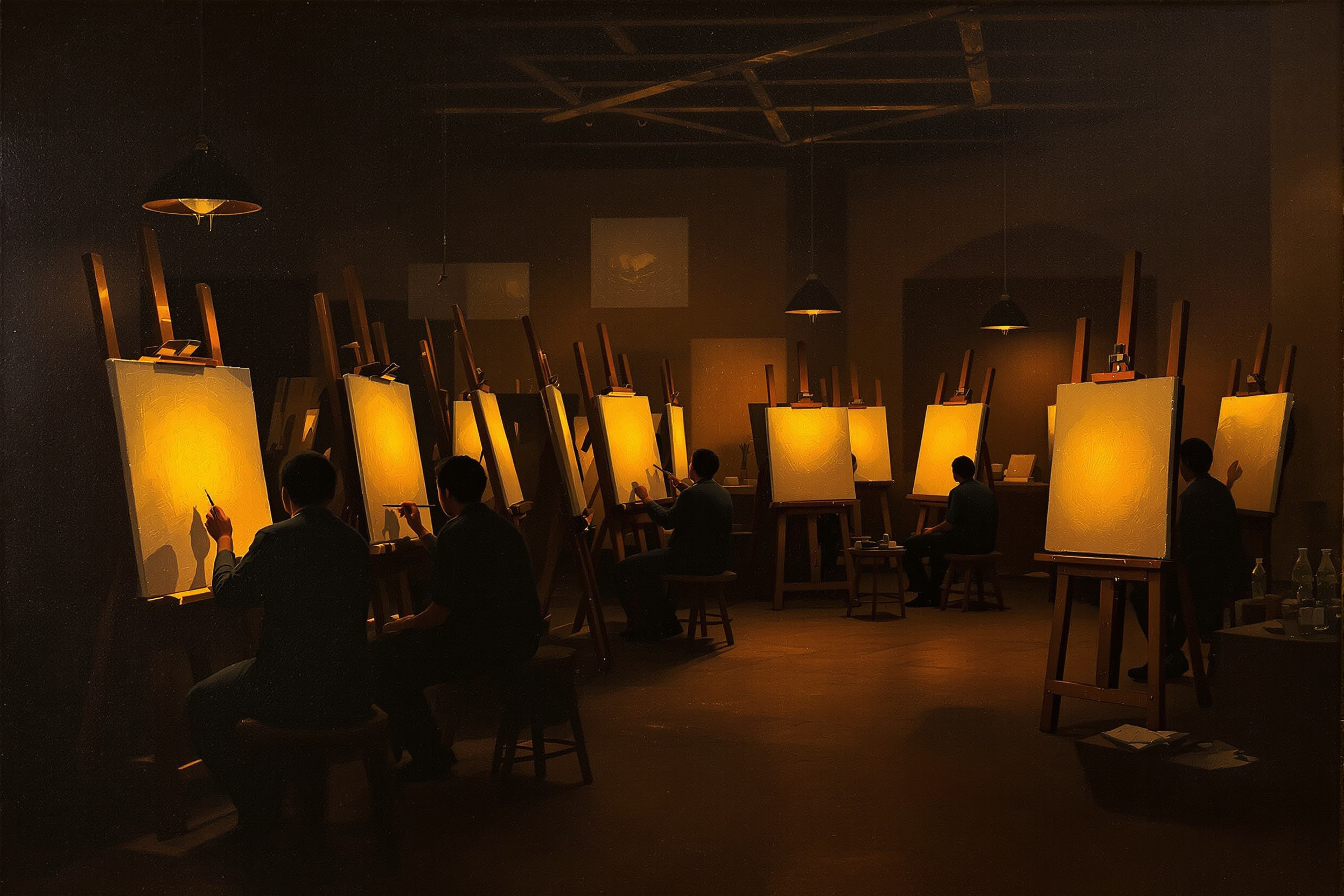
The Atelier Revival and the Nerdrum School
When the academies stopped teaching craft, the craft went underground — into private studios where a master again took apprentices, ground pigment beside them, and passed the method hand to hand.
For most of the twentieth century, the formal training that had produced centuries of skilled painters simply stopped. Art schools turned toward concept and self-expression and away from the disciplined study of drawing, anatomy and materials. A student who wanted to learn to paint a figure in the Old-Master manner often found there was nowhere left to learn it. The response, gathering force over recent decades, has been a revival of the atelier — the workshop studio in which a small number of students learn directly from a practising master.
What an atelier is
The atelier model is old. In it, learning is by apprenticeship rather than lecture: students draw from casts and the living model for long hours, grind and prepare their own materials, and progress through a structured sequence from careful drawing to fully realised painting. Feedback is constant, personal and technical. The organising bodies of the movement, such as the Art Renewal Center, maintain networks of these ateliers and argue, with some evidence, that they now produce more genuinely skilled figurative painters than the conventional art school.
The Nerdrum model
Within this broader revival, Odd Nerdrum occupies a distinctive place. Rather than founding an accredited school, he took apprentices into his own working studio in the most literal old-master fashion — a handful of pupils living and painting alongside the master, learning by watching, imitating and assisting. They studied his methods directly: the prepared ground, the limited earth palette, the patient glazing described in Old-Master Technique. Several went on to become accomplished figurative painters and teachers in their own right, and to carry both the craft and the Kitsch philosophy outward. The arrangement was informal, even eccentric, but it revived something the institutions had abandoned: transmission by presence.
Why direct transmission matters
Some knowledge resists the textbook. The feel of a loaded brush, the moment a glaze is dry enough for the next layer, the judgement of when a value is a hair too light — these are learned by doing, beside someone who already knows, far more efficiently than from any manual. This is the deep argument for the atelier: that craft is embodied, and embodied knowledge travels best from person to person. It is the same reason the workshops of the seventeenth century, whose products fill the Metropolitan Museum of Art, were organised as masters surrounded by pupils and assistants.
Community as much as curriculum
The atelier revival is not only a teaching method; it is how the movement reproduces itself socially. Students trained in a shared method, under teachers who read the same manifestos, form the human network described in The Kitsch Movement. When they open studios of their own, the lineage branches. In this way a tradition that the twentieth century pronounced dead has quietly rebuilt its own means of survival — one apprentice, one ground, one glaze at a time.
The long apprenticeship
None of this is quick. Atelier training is measured in years, and mastery in decades. That patience is itself a value the movement defends against a culture of speed — a wager that some things worth doing cannot be hurried, and that the slow transmission of craft is a form of cultural memory worth keeping alive.